Feb 23, 2026
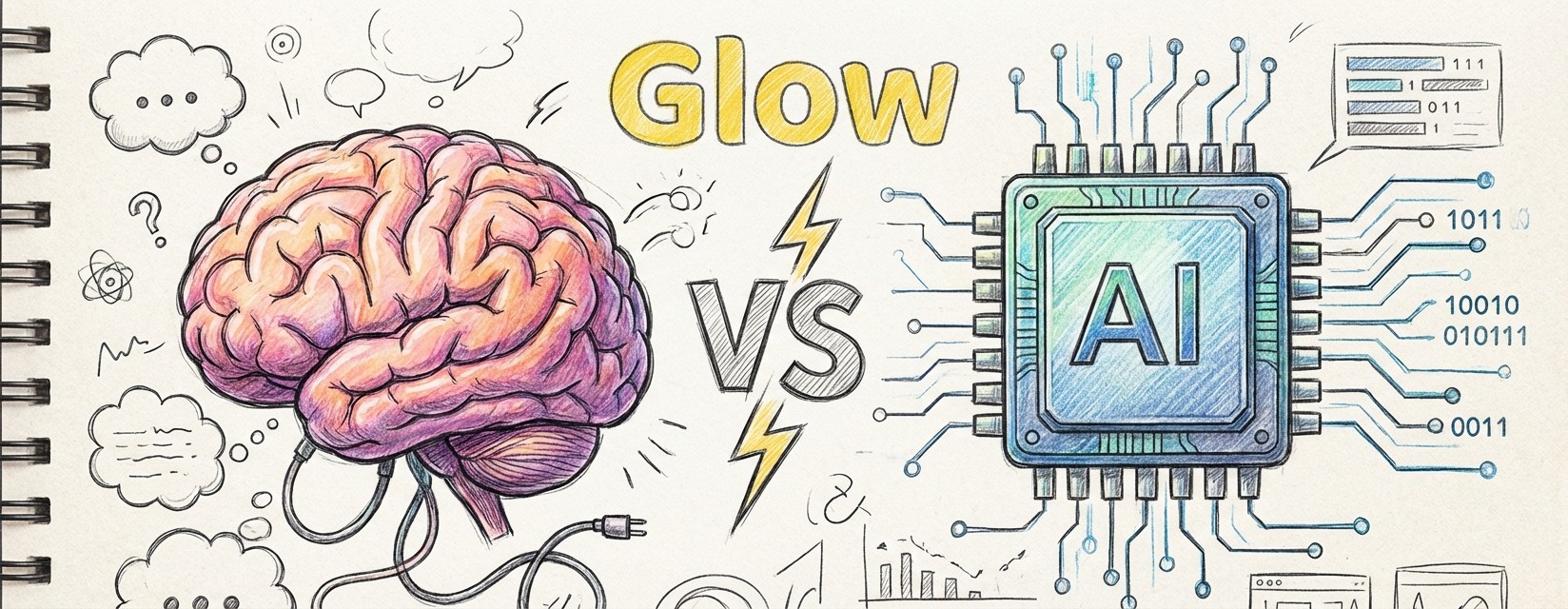
The Human Brain vs. Artificial Intelligence: A Numbers Game
When people compare human intelligence to artificial intelligence, they often focus on what each can do: play chess, write poetry, recognize faces, solve equations. But when we shift the lens to a numbers game - the raw physical metrics of brains versus machines - the story becomes both pretty mind-blowing. Let’s take a look.
Size and Weight
Human brain: A mere 1.3 - 1.4 kilograms, fitting neatly in your skull.
AI training cluster (1 trillion parameter scale): Dozens of server racks, weighing tens of tons, sprawling across an entire datacenter room.
The brain is portable and compact; training a state-of-the-art AI requires a warehouse.
Connections
Brain: ~86 billion neurons, connected by ~100 trillion synapses.
1 trillion-parameter AI model: Exactly 1 trillion adjustable weights.
In sheer connection count, your brain still has ~100× more connections than a trillion-parameter AI. But AI weights are static numbers; biological synapses are dynamic, self-adjusting, and time-sensitive - much richer in what they encode.
Storage Capacity (very rough estimates)
Brain: Somewhere in the range of 100–200 terabytes if you try to translate synapses into digital storage (though some scientists argue for up to a few petabytes).
1T-parameter AI model: 2–4 terabytes to store the weights, depending on precision.
That means your brain’s memory system is still larger, though not nearly as easy to back up!
Energy Use
Human brain: ~20 watts (about the power of a dim light bulb).
AI model, inference (answering a query): ~100 watts average during that burst of activity.
AI model, training: 5,000,000–10,000,000 watts (5–10 MW) continuously, for weeks or months.
This is where the contrast becomes staggering: the brain is astonishingly energy-efficient compared to AI. One brain consumes about the same power as a lightbulb. Training GPT-4 consumed enough energy to power a small town.
Communication Bandwidth
Human speech: ~15 bytes/second (150 words per minute).
Human reading: ~25 bytes/second.
Brain’s internal signaling: Far higher, but bottlenecked at the mouth, ears, and eyes.
AI data transfer (T/GPUs over NVLink): ~900,000,000,000 bytes/second.
In other words, a pair of AI T/GPUs can exchange more data in a single second than a human could speak in their entire lifetime.
The Mind-Blowing Takeaway
A single human brain fits in your hand, runs on 20 watts, and still outstrips the largest AI systems in connection complexity and energy efficiency.
A cutting-edge AI requires megawatts of power, thousands of T/GPUs, and rooms full of humming servers to approach certain types of human-level reasoning.
Yet when it comes to bandwidth - the sheer speed of information transfer - AI is unimaginably faster, moving bytes at rates humans can’t even conceptualize.
A Necessary Caveat
While these comparisons are fun, they’re also deeply imperfect. The human brain and modern AI operate in fundamentally different ways. Neurons are living, self-repairing, and constantly changing. Synapses don’t just store a number; they embody complex biochemical processes. AI parameters are simple numeric weights running on silicon chips. And crucially, AI isn’t conscious, self-aware, or experiencing anything - it’s processing patterns. It probably does not “understand” in the way a human does, even when it produces impressive outputs.
So while the numbers above can be mind-blowing, they’re best read as a playful cross-species/digital analogy, not a literal equivalence.
Final thought: If future AI could approach the brain’s efficiency and its adaptive, self-organizing qualities, not just its power, the impact would be revolutionary. Until then, your 20-watt skull-mounted supercomputer remains the most cost-effective intelligence engine in the known universe.