6 May 2026
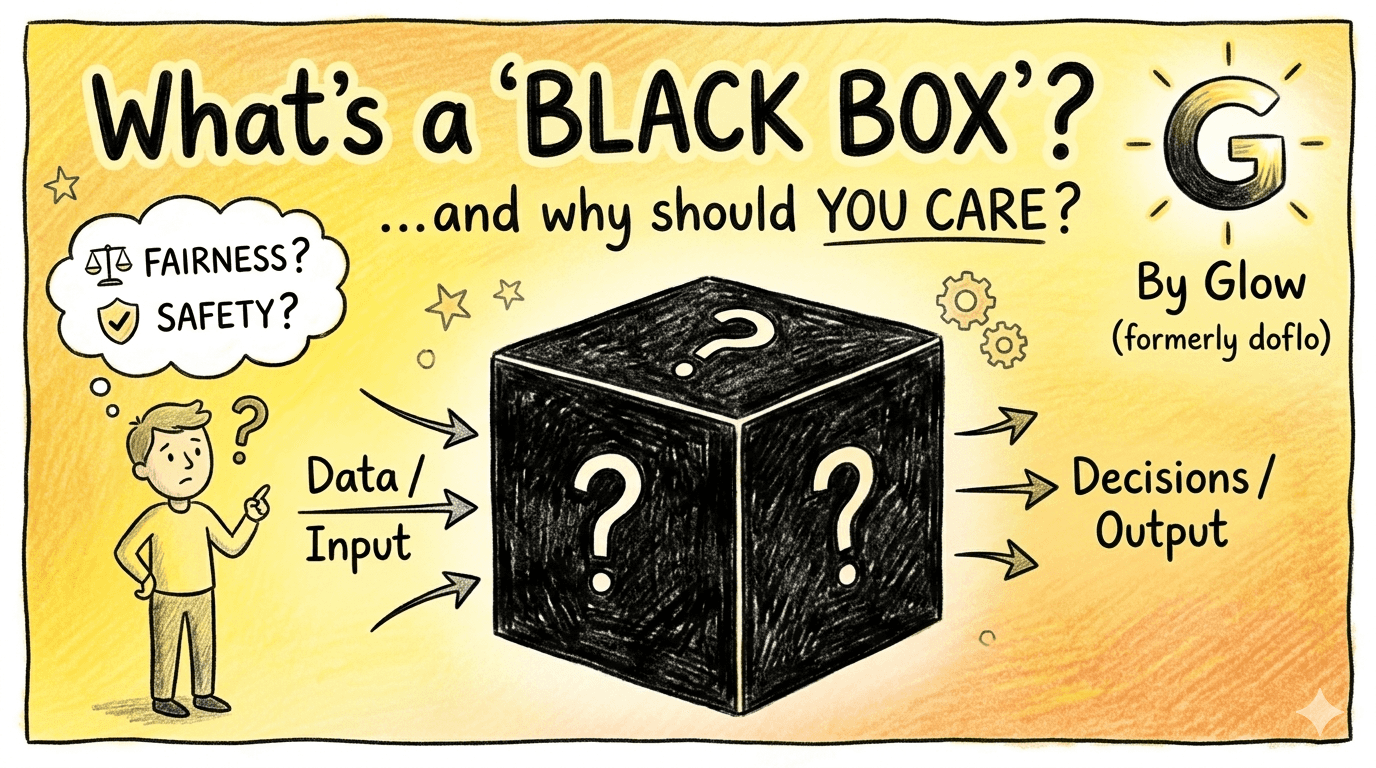
What’s a "Black Box" and Why Should You Care?
In the early days of aviation, a "black box" was a flight recorder, a device that captured every detail of a journey so that if something went wrong, we could find out exactly why.
In the world of AI, the term has taken on a more literal (and slightly more ominous) meaning. Today, a "Black Box" refers to an AI system where you can see what goes in (the prompt) and what comes out (the result), but the internal logic that connects the two is a total mystery.
For a hobbyist asking an AI to write a poem about a toaster, the "Black Box" is a curiosity. For a business using AI to manage customer data, financial reporting, or supply chains, it’s a liability.
Why the "Black Box" is a Business Risk
When an AI model operates as a monolith - one giant, opaque brain - you run into three major problems:
The Hallucination Trap: Because you can’t see the "reasoning" steps, you have no way of knowing if the AI is using a verified fact or a creative (and incorrect) guess until the damage is already done.
The Governance Gap: Regulators (and your legal team) generally dislike mysteries. If an AI makes a biased decision or a flawed calculation, "the algorithm did it" is not a valid legal defense.
"Trust Me" Engineering: Without visibility, you’re forced to rely on blind faith. You can’t debug a black box; you can only poke it and hope it behaves better next time.
How Glow Breaks the Box
The reason most AI feels like a black box is that users are trying to force a single, massive LLM to do everything at once. At Glow (formerly doflo), we’ve fundamentally redesigned how AI works for business.
Glow doesn't have a black box issue because our architecture is inherently transparent.
Instead of one giant, mysterious process, Glow utilizes programmatic workflows where specialized AI agents are split across defined, logical steps.
Micro-Agent Architecture: In Glow, one agent might be responsible for extracting data, another for verifying it against a source, and a third for drafting a response.
Visible Logic: Every single action taken by an agent is a discrete step in your workflow. You can see the "thinking" and the data transfer at every stage.
Programmatic Guardrails: Because the agents are governed by code-based logic (e.g., if Agent A finds a discrepancy, then trigger Agent B), the workflow is stable and predictable, not a "choose your own adventure" mystery.
The Added Bonus: Seamless Human-in-the-Loop (HITL)
Because Glow breaks the workflow into clear, programmatic steps, it unlocks a superpower that black-box AI can't handle: Human-in-the-Loop (HITL) governance.
Since you can see exactly where the AI is in the process, you can insert approval checkpoints exactly where they matter most. This makes your AI:
Auditable: You can see exactly which agent suggested which action and which human teammate gave the green light.
Governable: You can ensure that high-stakes decisions - like sending an invoice or updating a database - never happen without professional oversight.
Safe: Humans catch the edge cases that look like "logic" to a machine but "nonsense" to an expert.
The Bottom Line
You shouldn't have to wonder how your AI reached a conclusion. In a world of increasing regulation and rapid AI adoption, transparency is your greatest competitive advantage. By moving away from "Black Box" monoliths and toward Glow’s programmatic, agentic workflows, you aren't just automating - you're building a system that is auditable, governable, and, most importantly, trustworthy.
Ready to see inside the box? Start building your first transparent workflow with Glow today.
How would you like to see these "Human-in-the-Loop" checkpoints integrated into your current team's workflow?
Get started here!